


Keywords: cyclotron, cyclotron radiation protection, cyclotron bunker, cyclotron vault, accelerator shielding, radiation shielding, radiation protection, shielding calculation, cyclotron shielding design, concrete shielding, neutron shielding, 18 MeV cyclotron, PET cyclotron, accelerator facility, radionuclide production, F-18 production, nuclear medicine, radiation protection study, ionising radiation, radiation safety, cyclotron licensing Croatia
Introduction
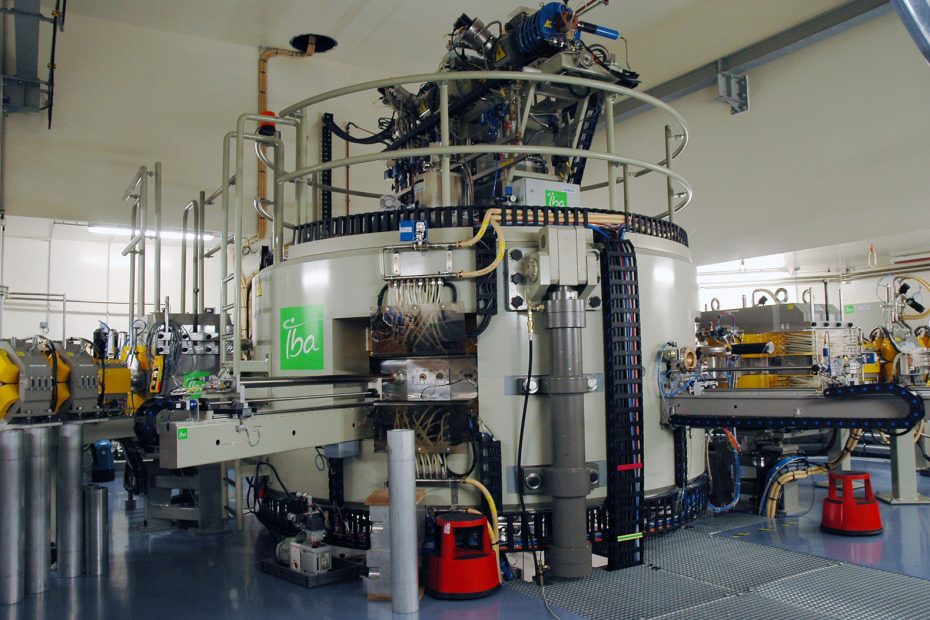
A cyclotron is a compact particle accelerator most commonly associated with the production of radionuclides for nuclear medicine, particularly radionuclides used in PET imaging.
Although the accelerator itself may be described as compact, its radiation protection requirements are anything but small.
During operation, a cyclotron can generate intense fields of secondary radiation, particularly neutrons and photons. The room housing the accelerator – commonly referred to as a cyclotron bunker or cyclotron vault – is therefore one of the more demanding types of radiation facilities to design.
Radiation protection is not simply a question of how many centimetres of concrete are required.
The entire facility has to be considered: walls, ceiling, floor, doors, maze, ventilation and cable penetrations, adjacent areas, workload and the expected future operation of the facility.
What is a cyclotron?
A cyclotron is an accelerator that uses electric and magnetic fields to accelerate charged particles, most commonly protons.
In medicine, compact cyclotrons are primarily used to produce short-lived radionuclides. One of the best-known examples is fluorine-18 (F-18), which is used to manufacture radiopharmaceuticals such as 18F-FDG.
A typical cyclotron facility therefore consists of much more than an accelerator room.
It may include:
- a cyclotron vault
- target systems
- radionuclide production areas
- hot cells
- radiopharmaceutical production and quality-control laboratories
- radioactive waste storage areas
- ventilation and monitoring systems
- controlled and supervised areas.
Radiation protection must therefore cover the entire process, from particle acceleration to the production and handling of radionuclides.
Why is cyclotron radiation shielding demanding?
In a conventional X-ray installation, photon radiation of relatively well-defined energies is the dominant radiation protection issue.
A cyclotron is more complex.
When accelerated protons interact with targets and surrounding materials, secondary radiation is produced. Neutrons are particularly important because of their penetrating properties and their significant influence on shielding design.
Radiation fields may include:
- prompt photon radiation
- secondary neutrons
- gamma radiation from activated materials
- radioactive products generated in the target
- activated cyclotron components and surrounding materials.
Cyclotron shielding calculations therefore differ substantially from conventional X-ray room shielding calculations.
Cyclotron bunker design
Cyclotrons are commonly installed inside purpose-designed rooms with massive radiation shielding barriers.
Terms frequently used include:
- cyclotron bunker
- cyclotron vault
- accelerator bunker
- accelerator vault.
Concrete is the most common structural shielding material because it provides useful attenuation of both photon and neutron radiation and allows very thick shielding structures to be constructed economically.
However, nominal wall thickness alone does not define shielding performance.
A shielding calculation also needs to consider:
- concrete density
- concrete composition
- barrier geometry
- cyclotron position
- target position
- radiation directions
- distance to the outer surface
- occupancy of adjacent areas.
A concrete wall of a particular thickness does not automatically provide the same level of protection in every cyclotron facility.
How thick should cyclotron bunker walls be?
This is one of the first questions asked when planning a cyclotron facility.
There is no single universal answer.
Required shielding thickness depends on factors including:
- maximum proton energy
- maximum beam current
- cyclotron design
- number and type of targets
- expected workload
- operating time
- simultaneous target irradiation
- cyclotron position within the vault
- distance to adjacent areas
- occupancy of surrounding rooms
- design dose constraints
- density and composition of the shielding material.
Shielding therefore needs to be calculated for the specific accelerator and facility.
Wall thickness copied from another cyclotron installation can be useful as a preliminary reference, but it cannot replace a project-specific radiation shielding calculation.
The 18 MeV cyclotron
Cyclotrons with proton energies around 18 MeV are widely used for radionuclide production in PET and other nuclear medicine applications.
However, two cyclotrons with the same nominal energy can have very different shielding requirements.
An 18 MeV cyclotron operating at relatively low beam current for a limited number of hours per week does not represent the same radiological workload as an accelerator operating every day at high current for intensive radionuclide production.
The value “18 MeV” alone is therefore insufficient.
A proper shielding assessment also requires beam current, workload, target configuration and expected operating conditions.
Beam current matters as much as energy
Cyclotron shielding discussions often focus primarily on proton energy.
Beam current is also a critical parameter.
A higher current means that more protons reach the target per unit time and, in general, greater quantities of secondary radiation can be produced.
Shielding should therefore be designed for the maximum reasonably expected operating conditions rather than only for the initial production schedule.
This becomes particularly important when future production expansion is possible.
A vault designed only around the first months of operation can later become a significant limitation on the entire facility.
Neutron shielding
Neutrons are one of the main reasons why cyclotron facilities require substantial shielding structures.
Unlike X-ray or gamma radiation, lead is not automatically the preferred shielding material for neutrons.
Materials containing light nuclei, particularly hydrogen, are effective for slowing neutrons.
Depending on the application, neutron shielding materials may include:
- concrete
- water
- polyethylene
- borated polyethylene
- specialised composite shielding materials.
For large cyclotron vaults, concrete is typically the principal shielding material because of its mass, composition, structural properties and cost-effectiveness.
Walls are only part of the shielding system
A cyclotron vault has to be considered as a complete shielding envelope.
This includes:
- walls
- ceiling
- floor
- entrance
- shielding doors
- maze
- ventilation ducts
- pipes
- cable penetrations
- service penetrations.
A relatively small penetration through a massive wall can become the weakest radiological point of the entire bunker.
Penetrations should therefore not be added later without an assessment of their effect on radiation shielding.
Does the cyclotron floor require shielding?
The floor is part of the shielding envelope.
The required shielding depends strongly on what is located beneath the cyclotron vault.
If occupied rooms are located below the facility, floor shielding can be a major design consideration.
Where the bunker is constructed directly on the ground, the geometry may be more favourable, but the floor should not automatically be ignored.
Secondary radiation, material activation and possible future use of areas around the facility still need to be considered.
The same principle applies to the roof.
A roof cannot automatically be regarded as an unrestricted radiation direction, particularly where scattered radiation and skyshine may be relevant.
Maze and shielding doors
When concrete bunker walls become very thick, construction of doors providing an equivalent level of shielding can become technically difficult and expensive.
Cyclotron facilities therefore often incorporate a maze entrance.
The principle is straightforward: there is no direct line of sight between the cyclotron and the bunker entrance.
A properly designed maze can substantially reduce radiation levels at the entrance and reduce shielding requirements for the final door.
The maze itself, however, requires calculation.
Its length, width, number of turns and orientation relative to the cyclotron all influence the radiation level at the exit.
Ventilation, pipes and cable penetrations
Cyclotron bunker design does not end when the thickness of four walls has been specified.
Every penetration through the shielding represents a potential pathway for radiation.
Particular attention should be given to:
- ventilation ducts
- electrical and communication cables
- cooling pipes
- radionuclide transfer lines
- service penetrations.
Where practicable, penetrations are designed with bends, offsets or other geometrical arrangements that avoid a direct radiation path through the shielding.
These details are much easier to solve during the design stage.
Correcting an unsuitable penetration through metres of reinforced concrete after construction is considerably more difficult.
Activation of the cyclotron and surrounding materials
Cyclotron radiation protection does not end when the beam is switched off.
Neutrons can activate accelerator components, structural materials and some components of the surrounding concrete.
Measurable radiation fields may therefore remain after intensive operation even when the accelerator is no longer producing a beam.
Activation is particularly relevant during:
- cyclotron servicing
- target replacement
- maintenance
- major refurbishment
- accelerator replacement
- final decommissioning.
Material selection during the design stage can therefore have consequences many years later.
Self-shielded cyclotrons
Self-shielded cyclotrons incorporate a substantial amount of shielding directly around the accelerator.
This can significantly reduce structural shielding requirements and may allow cyclotrons to be installed in facilities where a conventional massive vault would not be practical.
However, “self-shielded” does not mean that radiation shielding design is unnecessary.
The assessment still needs to address:
- radiation outside the integrated shielding
- access points
- adjacent rooms
- service penetrations
- radionuclide production
- hot-cell operations
- maintenance and abnormal situations.
Radionuclide production and hot cells
The cyclotron is only the first stage of the process.
After irradiation, the produced radionuclide is transferred to systems used for processing and radiopharmaceutical production.
At this stage, neutron radiation from the accelerator may no longer be the primary radiation protection concern. Photon radiation from radionuclides and the possibility of radioactive contamination become increasingly important.
Hot cells with dedicated shielding and ventilation systems are therefore commonly used.
Cyclotron facility design should integrate:
- cyclotron shielding
- radionuclide shielding
- contamination control
- ventilation
- controlled-area design
- radioactive waste storage.
Radiation safety depends on the performance of the entire facility, not just the accelerator vault.
Radiation Protection Study and shielding calculation
One of the key stages in planning a cyclotron facility is the preparation of a Radiation Protection Study and detailed shielding calculations.
For a cyclotron facility, the assessment may include:
- accelerator characteristics
- proton energy and beam current
- expected workload
- secondary radiation sources
- vault geometry
- wall shielding calculations
- roof and floor shielding
- maze analysis
- shielding doors
- service penetrations
- surrounding areas
- assessment of worker and public exposure.
The best time to perform these calculations is before the architectural and structural design has been finalised.
Radiation protection should be designed before construction
Design errors in cyclotron facilities can be extremely expensive to correct.
Adding a few millimetres of shielding to a conventional X-ray room and adding tens of centimetres of reinforced concrete to an already completed cyclotron bunker are entirely different construction projects.
Radiological requirements should therefore be considered from the beginning.
The Radiation Protection Expert should work together with:
- the investor
- architect
- structural engineer
- mechanical engineer
- electrical engineer
- cyclotron manufacturer
- future facility operator.
Radiation shielding is not an accessory added to the building design. It is one of the fundamental design inputs.
Cyclotron licensing in Croatia
A cyclotron is an accelerator producing ionising radiation and its use is subject to radiation protection and regulatory requirements.
Before operation begins, the applicable licensing requirements, technical documentation and radiation safety conditions need to be identified.
The regulatory process should not first be considered after the cyclotron has been ordered or the bunker has been constructed.
Technical characteristics of the accelerator, room design, radiation shielding, operational arrangements and radiation protection measures are closely linked to the licensing documentation.
Shielding design, the Radiation Protection Study and regulatory preparation should therefore be treated as interconnected parts of the same project.
Verification after construction
A shielding calculation is not the end of the project.
After construction and installation, the completed facility should be checked against the approved design.
Particular attention should be paid to:
- actual shielding dimensions
- concrete properties
- shielding doors
- structural joints
- service penetrations
- modifications made during construction.
Radiation measurements under representative operating conditions can then be used to verify shielding performance and identify potential weak points.
Common mistakes in cyclotron shielding projects
Problems often arise when:
- radiation protection is considered only after the architectural design is completed
- wall thickness is copied from another facility
- proton energy is considered while beam current and workload are ignored
- walls are calculated but the roof and floor are neglected
- cable and ventilation penetrations are overlooked
- the maze is considered too late
- future production increases are ignored
- activation is not considered
- licensing documentation is started only shortly before commissioning.
For a facility expected to operate for decades, these mistakes can cost considerably more than proper design at the beginning of the project.
Frequently Asked Questions
How much concrete is required for a cyclotron bunker?
There is no universal thickness. Required shielding depends on proton energy, beam current, target configuration, workload, geometry, distances, surrounding occupancy and concrete properties. The thickness should be determined by a project-specific shielding calculation.
Is lead suitable for cyclotron shielding?
Lead is highly effective for photon radiation, but it is not a universal solution for neutron radiation. Large cyclotron vaults generally rely primarily on concrete, with additional materials used where required.
Does every cyclotron require a bunker?
It depends on the accelerator design. Conventional non-self-shielded cyclotrons require substantial structural shielding. Self-shielded systems incorporate shielding around the accelerator but still require a radiological assessment of the installation room and surrounding areas.
Do the floor and roof need shielding calculations?
Yes. The shielding structure needs to be considered in three dimensions. Required protection depends on what is located above and below the vault and on possible pathways for secondary radiation.
When should the shielding calculation be performed?
As early as possible, ideally before the architectural and structural design is finalised.
Who should perform cyclotron shielding calculations?
Shielding calculations and the professional radiation protection assessment should be prepared by an appropriately qualified Radiation Protection Expert in accordance with the applicable regulatory requirements and the specific project.
Good radiation shielding starts before the first concrete is poured
A cyclotron vault is a structure where proper design is far less expensive than later reconstruction.
Cyclotron energy, beam current, targets, workload, neutrons, surrounding rooms, concrete, maze, doors and service penetrations all need to be considered as parts of a single system.
Radiation protection therefore does not begin after the accelerator has been installed.
It starts before construction – with a proper shielding calculation, Radiation Protection Study and well-designed facility.
TRICIJ d.o.o. provides professional radiation protection services including Radiation Protection Studies, radiation shielding calculations, shielding design and regulatory support for accelerators and other sources of ionising radiation in Croatia.