


Keywords: radiation protection study, radiation shielding, shielding design, radiation protection, ionising radiation, radiological protection, X-ray room shielding, lead shielding, nuclear medicine shielding, radiotherapy shielding, radiation safety
Introduction
When working with ionising radiation, having a quality device and personal dosimeters is not enough. One of the most important elements of radiation safety is properly designed radiation shielding.
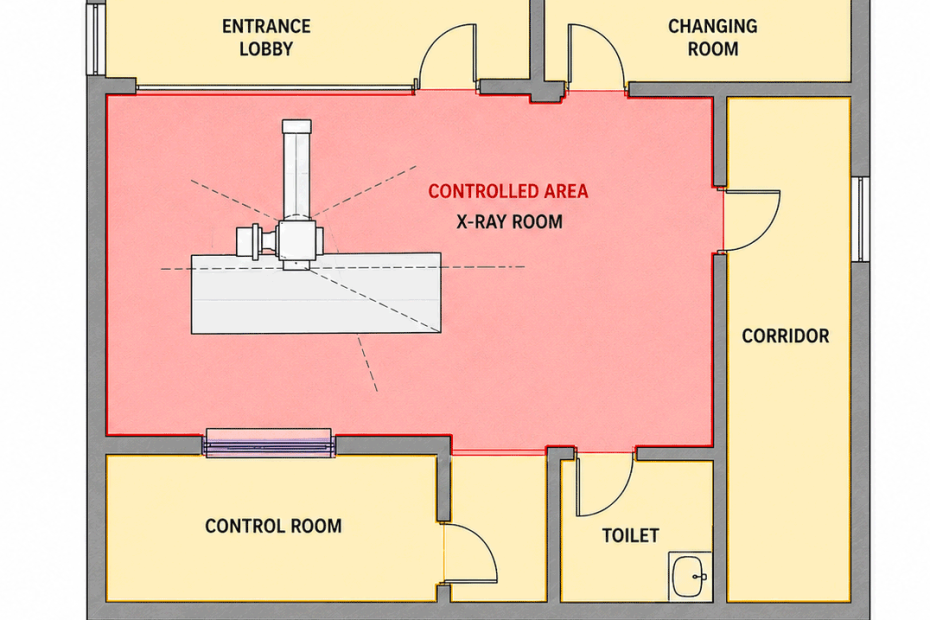
The foundation of every quality shielding project is a radiation protection study. This document serves as the basis for defining shielding requirements, protective barrier thicknesses, room layout and radiation safety conditions.
If the study is prepared poorly or too late, problems often cannot be corrected later without expensive reconstruction work and additional costs.
What is a radiation protection study?
A radiation protection study is a professional document used to assess radiological conditions and define the required protective measures for a facility.
Based on the study, the following are determined:
- required wall, door and window shielding
- room layout
- area classification
- controlled and supervised areas
- assessment of possible exposure
- radiation safety conditions
- required measurements and controls
In other words, the study is not just administrative paperwork. It is the technical foundation of the entire radiation protection project.
What does radiation shielding design actually mean?
Shielding design includes technical and structural solutions used to reduce radiation exposure for workers, patients and people in surrounding areas.
In practice, this includes the design of:
- walls
- doors
- lead glass
- ceilings and floors
- protective barriers
The goal is to ensure that radiation levels outside controlled areas remain within regulatory limits.
The required protection depends on:
- the type of radiation source
- radiation energy
- equipment workload
- usage time
- distance from the source
- purpose of adjacent rooms
Shielding requirements for a dental X-ray room are completely different from those for CT, radiotherapy or nuclear medicine facilities.
Why is the radiation protection study the most important part?
In practice, shielding design is often started too late — only after the facility has already been built or renovated.
This usually leads to problems such as:
- insufficient wall shielding
- doors and windows with inadequate protection values
- poor room layout
- expensive and complicated reconstruction work
A properly prepared radiation protection study ensures that all requirements are defined before construction work and equipment installation begin.
This saves time, reduces costs and minimises the risk of serious problems once the facility becomes operational.
Common mistakes in shielding design
In real projects, the same problems appear repeatedly:
- the radiation protection study is prepared too late
- generic assumptions are used instead of real operational parameters
- adjacent rooms are ignored
- scatter and secondary radiation are underestimated
- documentation does not match the actual installation
A common issue is when shielding is designed without proper radiation protection expertise, leading to the classic approach of “just add more lead”.
That is not engineering. That is improvisation.
Good radiation protection starts with proper planning
When the radiation protection study and shielding design are done properly, most people will never even notice the protection itself. And that is exactly the point of good radiation safety.
Radiation protection does not begin after equipment installation. It starts much earlier – with a properly prepared study and carefully designed shielding.