


Keywords: Radithor, Radium Girls, radium, radium-226, radium-228, radiation protection, radioactivity, internal exposure, occupational exposure, history of radiation protection
Introduction
At the beginning of the twentieth century, radioactivity did not have the reputation it has today.
Radium was new, fascinating and extraordinarily valuable. It appeared in medicine, cosmetics and various products to which almost miraculous properties were attributed. Radioactivity became associated with energy, health and technological progress.
The problem was that the use of radium developed much faster than our understanding of its biological effects and the principles required for its safe use.
Two stories from this period illustrate the consequences particularly well.
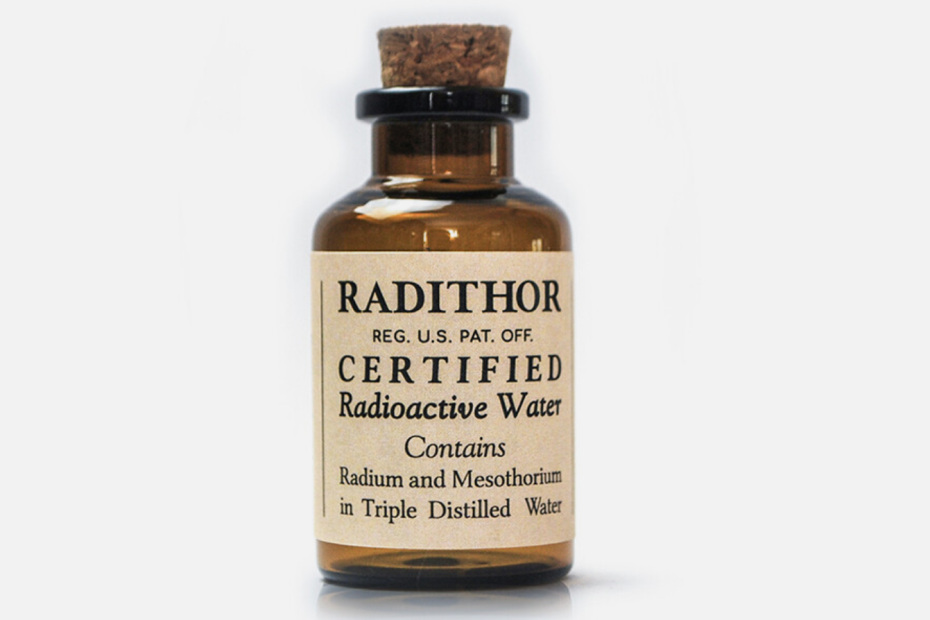
The first is Radithor, a radioactive preparation sold for oral consumption. The second concerns the women who painted watch and instrument dials with radium-containing luminous paint and later became known as the Radium Girls.
Although apparently different, both stories involve the same fundamental radiation protection problem: the intake of radium into the human body.
Radium as a Symbol of Progress
Radium was discovered by Marie and Pierre Curie in 1898. Its intense radioactivity and unusual properties rapidly attracted the attention of scientists, physicians, industry and the general public.
Medical applications of ionising radiation genuinely opened entirely new areas of diagnosis and treatment. However, during the early twentieth century, the boundary between scientifically justified medical applications and pseudomedicine was often poorly defined.
Numerous products appeared on the market whose supposed benefits were attributed specifically to their radioactive content.
One of the most notorious was Radithor.
Radithor – Radioactive Water as Medicine
Radithor was manufactured by Bailey Radium Laboratories in the United States during the 1920s.
It was not merely a product that claimed to be radioactive.
Radithor actually contained radium.
The preparation contained radium-226 and radium-228 dissolved in water. Historical sources report an activity exceeding approximately 2 µCi, or about 74 kBq, per bottle.
It was marketed as a general health tonic and was claimed to treat a remarkable range of diseases and disorders.
In other words, customers were paying to drink radioactive material.
Eben Byers and Thousands of Bottles of Radithor
The most famous user of Radithor was the American industrialist and sportsman Eben M. Byers.
Following an injury, Byers began taking Radithor on the recommendation of a physician. Convinced that the preparation was helping him, he continued consuming it in large quantities.
Historical accounts indicate that he drank more than a thousand bottles over several years.
The consequences were catastrophic.
He developed severe damage to his bones and jaw together with other effects of prolonged internal irradiation. He died in 1932.
His case became a major news story and contributed to the end of an era in which radioactive preparations could be sold with little effective control as health products.
To understand why radium intake can be so dangerous, it is necessary to consider what happens after radium enters the body.
Why Does Radium Accumulate in Bone?
Radium belongs to the same chemical group as calcium, and because of their chemical similarities the human body can partially treat the two elements in a similar way.
After radium enters the bloodstream, some of it can become incorporated into bone.
This is where the central problem begins.
Radium-226 has a physical half-life of approximately 1,600 years. Once incorporated into bone, it can therefore act as a long-term internal source of ionising radiation.
Radium-226 decays predominantly through alpha emission.
Alpha particles have a very short range in tissue but a high ionising capability. During external exposure, the outer layer of the skin is generally sufficient to stop them. When an alpha-emitting radionuclide is located inside the body, the situation is entirely different.
Its energy is deposited directly in nearby tissue.
The location of the radionuclide therefore becomes critically important when assessing the risk.
For radium, the skeleton is particularly important.
The Radium Girls
At approximately the same time, radium had a genuinely useful industrial application.
When combined with phosphorescent materials, it could be used to produce paint that glowed without requiring an external source of energy. Such paint was ideal for watches, military instruments and other devices that needed to remain readable in darkness.
Applying the paint precisely required extremely fine brushes.
The workers, predominantly young women, needed to keep the tips of their brushes exceptionally sharp. In some factories, the accepted technique was to shape the brush using the lips.
Brush into the paint.
Brush between the lips.
Back into the paint.
Repeated hundreds of times during a working day.
The practice seems extraordinary today, but before the mid-to-late 1920s it was common. Modern epidemiological reconstruction indicates that almost half of the studied workers had been hired before 1930, when the practice of placing brushes in the mouth had essentially ceased.
Each time a worker shaped the brush with her lips, she could ingest a small quantity of radium-containing paint.
Each individual intake was small.
Repeated over months and years, the total intake was not.
When the Consequences Appeared
Serious health problems eventually began to develop among some of the workers.
Among the best-known consequences were necrosis of the jaw, anaemia, bone fractures and malignant bone tumours. Historical and subsequent epidemiological studies linked occupational radium intake with serious late health effects.
An important characteristic was that the consequences did not necessarily appear immediately after exposure.
Radium incorporated into bone continued irradiating surrounding tissue long after employment had ended.
The worker had left the workplace.
The radiation source had not.
Radithor and the Radium Girls Are Essentially the Same Story
At first sight, these appear to be two entirely different events.
Eben Byers voluntarily consumed a product containing radium.
The Radium Girls were occupationally exposed while performing their work.
From a radiation protection perspective, however, they share a crucial feature: internal contamination with a radionuclide that can remain within the body.
With external irradiation, exposure generally ends when the individual moves away from the source or when the source is removed.
Internal contamination is different.
A radionuclide can remain in the body and continue depositing energy in tissue for an extended period. The resulting dose depends on the activity taken into the body, the type and energy of radiation emitted, the radionuclide’s biokinetics, its physical and biological retention, and the organs in which it accumulates.
This is why modern radiation protection clearly distinguishes external irradiation from radionuclide intake.
Events That Changed Radiation Protection
The tragedy of the radium dial workers did not remain merely a historical example of occupational disease.
Their cases, legal proceedings and subsequent scientific investigations significantly influenced the development of occupational radiation protection.
Data collected from workers in the luminous dial industry were used for decades to investigate relationships between radium intake, absorbed dose to the skeleton and late health effects.
The influence was practical as well.
Experience gained from radium exposure contributed to the foundations on which later systems of occupational radiation control were developed. By the time of the Manhattan Project, substantially stricter radiation protection procedures were being applied, partly because of lessons learned from the radium dial workers.
Modern rules prohibiting eating and drinking in areas where contamination may occur, surface and airborne contamination monitoring, personal protective equipment, workplace monitoring and assessment of internal exposure are not merely administrative requirements.
There is very concrete historical experience behind many of them.
What Did We Learn?
Radithor and the Radium Girls belong to a period in which humanity already knew how to produce and commercially exploit radioactive materials but had not yet developed an adequate system for using them safely.
That may be their most important lesson.
The danger did not arise from radium alone.
It arose from a combination of technological optimism, insufficient understanding of biological effects, inadequate working practices and almost non-existent regulatory control.
Today, our understanding of ionising radiation is vastly greater. We have dosimetry, regulatory systems, dose limits, contamination control, radionuclide intake assessments and an established culture of radiation safety.
Much of that knowledge did not originate solely in laboratories.
It also came from analysing events in which adequate protection did not exist.
Radithor and the Radium Girls remain among the clearest examples of why radiation protection exists.