


Keywords: radiation protection, time, distance, shielding, inverse square law, ALARA
Introduction
Radiation protection is often perceived as complex, but its foundation is simple.
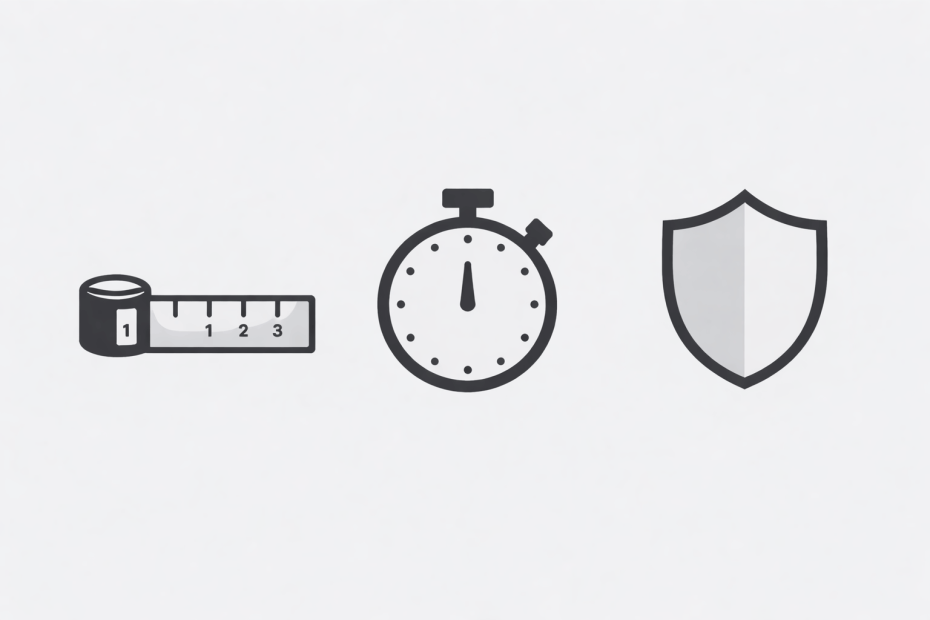
The three core principles: time, distance and shielding form the basis of nearly all radiation safety systems, from medical applications to industrial use.
Their importance lies not in theory, but in everyday practice.
Time
The dose received by an individual is proportional to the time spent in a radiation field.
Reducing exposure time directly reduces dose.
In practice, this involves:
- planning tasks in advance
- minimising unnecessary exposure
- optimising procedures
Time is the easiest parameter to control, yet often the least consistently managed.
Distance
Distance is often the most effective protective measure.
This is governed by the inverse square law, which states that radiation intensity decreases with the square of the distance from the source.
In practical terms:
- doubling the distance → dose reduced by a factor of 4
- tripling the distance → dose reduced by a factor of 9
This occurs because radiation spreads over a larger area as distance increases.
In real applications:
- stepping back is often more effective than adding shielding
- distance is cost-free, but underused
The limitation: the law applies best to point sources and simplified geometries.
Shielding
Shielding involves placing material between the source and the worker to reduce radiation intensity.
Depending on radiation type:
- alpha → stopped by air or skin
- beta → plastic or metal
- gamma and neutrons → lead, concrete or water
Shielding works by absorbing or scattering radiation before it reaches the body.
In practice:
- it is the most visible protective measure
- but not always the most effective if time and distance are neglected
Combined effect
These principles are not independent, they work together.
- time → linear effect on dose
- distance → exponential effect
- shielding → material-dependent attenuation
Effective radiation protection always combines all three.
Conclusion
Time, distance and shielding are not abstract concepts.
They are practical tools:
- how long you stay
- how far you are
- what stands between you and the source
Often, the simplest action is also the most effective: increasing distance.