


Keywords: radiation shielding barriers, shielding design, radiation protection standards, medical shielding, industrial shielding
Introduction
Radiation shielding barriers are a fundamental element of protection against ionising radiation – in both medical and industrial applications. Poorly designed barriers can result in insufficient protection for workers, patients and the public. This article explains what current standards require, how to properly design shielding barriers, and how to verify their performance in practice.
What are shielding barriers and why are they important
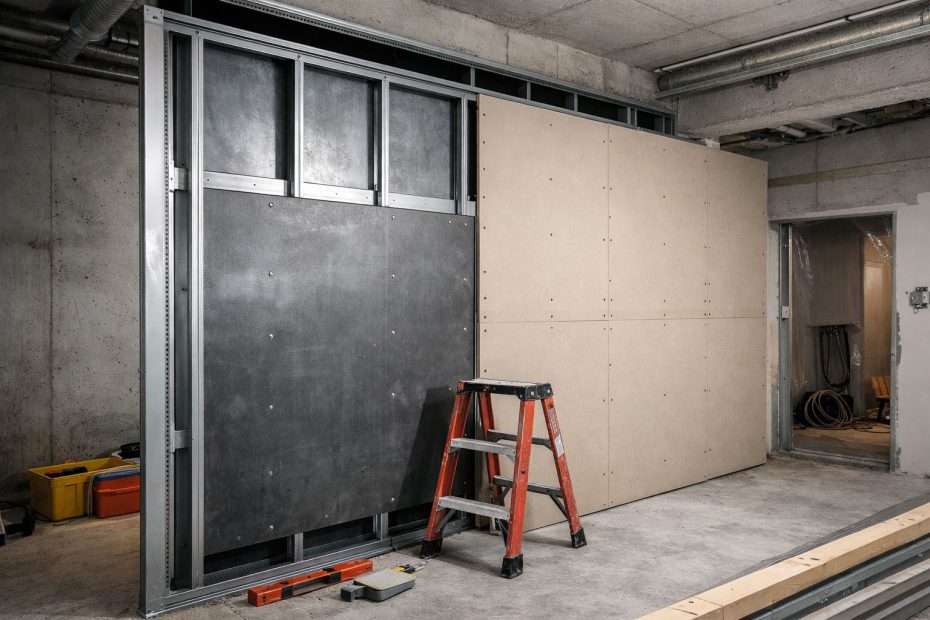
Shielding barriers are defined as physical structures (walls, panels, windows or movable screens) designed to reduce radiation dose outside controlled areas where radiation sources are used. Their purpose is to:
- protect workers, patients and the public
- ensure compliance with regulatory dose limits
- enable safe operation of high-dose equipment (X-ray, CT, industrial radiography)
In medical facilities, the focus is often on protecting adjacent rooms and occupied areas, while in industry the challenge is frequently related to high-energy, highly penetrating radiation beams, such as those used in industrial radiography or isotope applications.
Standards and guidance – regulatory framework
In Croatia and across the EU, shielding design is generally based on:
- IAEA Safety Standards (e.g. GSRs and SSRs)
- ICRP recommendations
- National regulations and guidance issued by competent authorities
- Relevant EN standards for medical and industrial radiation equipment
These documents define:
- dose limits (e.g. 1 mSv/year for the public, occupational reference levels)
- calculation models and formulae (attenuation, build-up, scatter)
- shielding materials and attenuation coefficients
- additional design requirements (labyrinths, doors, windows, penetrations)
Shielding design — step by step
1) Definition of source parameters
The first step is a clear definition of:
- type of radiation source or equipment (X-ray, CT, radionuclides)
- beam energy and output
- workload and operating режим
- primary beam direction and potential scatter
These parameters directly determine the required shielding material and thickness.
2) Selection of materials and thickness
The most commonly used materials for radiation shielding barriers include:
- lead (Pb) – highly effective for photon radiation, allowing small thicknesses, but structurally and execution-wise demanding
- concrete – the standard solution for large installations and higher energies, particularly in industrial applications
- steel and specialised composites – used less frequently, mainly for specific technical solutions
- barium-sulphate enhanced gypsum boards (e.g. Knauf Safeboard, Rigips X-Ray Protection) – increasingly used in medical facilities
Gypsum boards containing barium sulphate represent a practical alternative to traditional lead linings, especially in:
- X-ray and CT diagnostic rooms
- dental practices
- smaller medical installations where extreme beam energies are not involved
Their advantages include:
- easy installation without handling lead
- homogeneous shielding, reducing the risk of gaps typical of lead sheets
- good adaptability for refurbishment projects
- manufacturer-declared lead equivalence, dependent on beam energy
Shielding with these systems must never be designed empirically. Proper design requires:
- use of manufacturer-provided lead equivalence data for the relevant energies
- consideration of the number of layers, overlaps and joint treatment
- verification of shielding continuity, particularly at penetrations, doors and corners
The overall design still relies on standard shielding calculations (TVL, workload, occupancy factors), with the required lead equivalence achieved through multiple layers of barium-loaded gypsum boards rather than solid lead sheets.
3) Calculation and modelling
Recommended approaches include:
- analytical calculations using standard formulae
- radiation shielding software compatible with IAEA/NCRP methodologies
- Monte Carlo simulations for complex geometries
Calculations must reflect real room dimensions, beam directions and possible scatter contributions.
4) Practical construction elements
In addition to walls, shielding design often includes:
- labyrinths instead of direct openings
- shielded doors with proper sealing
- lead-equivalent glass windows
All components must ensure continuous shielding integrity without weak points.
Verification of shielding barriers
In-situ dose measurements
After construction or installation:
- radiation measurements are performed at multiple locations
- background dose and source contribution are assessed
- compliance with dose limits for workers and the public is verified
This verification is mandatory prior to commissioning and must be fully documented.
Documentation review
Shielding designs and calculations must be:
- approved and signed by a Radiation Protection Expert (RPE)
- archived as part of the radiation protection documentation
- available for regulatory inspection
Documentation typically includes calculations, drawings and measurement reports.
Common mistakes and how to avoid them
- non-conservative assumptions in calculations
- neglecting scatter and realistic workloads
- poor control of construction quality and deviations from design
The solution is straightforward: involve a qualified radiation protection expert and combine theoretical calculations with real-world measurements.
Conclusion
Designing and verifying radiation shielding barriers is not a formality – it is a core element of radiation safety and regulatory compliance. Applying current standards, correctly defining source parameters and performing thorough verification ensures that shielding barriers perform as intended.